Swedish snus
A moist, tobacco-containing oral product, sold loose or in portions. A white outer pouch does not mean that the filling is tobacco-free.

A plain-language guide to pouches, cigarettes, snus and pharmacokinetics—the way nicotine moves through the body over time.
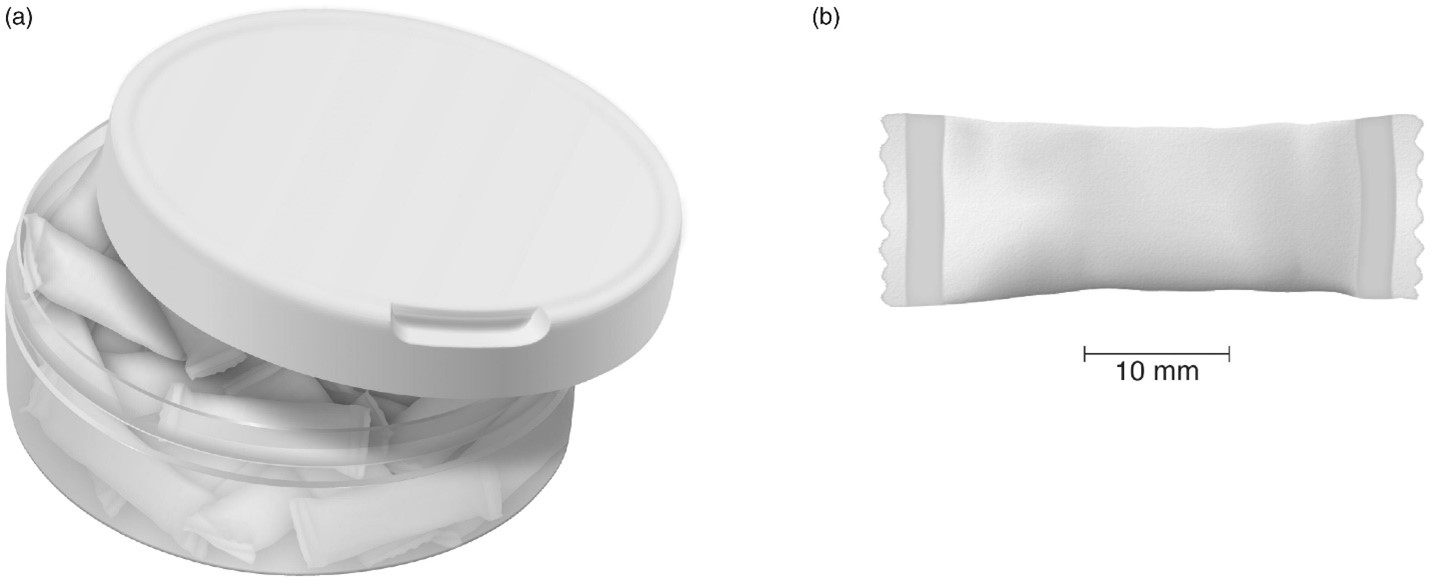
Nicotine is absorbed through the lining of the mouth when a nicotine pouch is used.
Image: FDA ↗They can look alike and are both used in the mouth without burning. The important distinction is what is inside, not whether the pouch looks white.
A moist, tobacco-containing oral product, sold loose or in portions. A white outer pouch does not mean that the filling is tobacco-free.
A fibre pouch containing nicotine, fillers and other ingredients. Nicotine may come from tobacco or be made synthetically. “Tobacco-free” does not mean nicotine-free or risk-free. CDC explanation ↗
Swedish moist oral snuff developed into the form now called snus. Historical account by manufacturer-affiliated authors ↗
Swedish Match dates the introduction of portion snus to 1973. Manufacturer history ↗
CDC dates nicotine pouches’ entry into the US market to 2016. Their health evidence therefore has a much shorter history. CDC background ↗
Burning tobacco creates a different exposure profile. FDA has authorised specific reduced-risk claims for eight General Snus products and, in June 2026, twenty ZYN products, compared with cigarettes. These findings concern the named products and replacing cigarettes, not a blanket statement about every snus or pouch.
No tobacco leaf is a compositional difference, not a complete health assessment. Product chemistry, strength and use patterns matter. Separate findings against cigarettes do not establish that all pouches and snus have equal risks, or support a universal percentage difference between them.
Long-term pouch evidence remains limited. A nicotine-content measurement alone cannot rank overall health risk. Evidence limitations ↗
Sources checked 15 November 2026 · Swedish snus is not interchangeable with every form of smokeless tobacco.
“Pouch” describes a format. It does not tell you whether a product contains tobacco leaf or how its nicotine is delivered.[1][2]
Small fibre pouches containing nicotine, fillers and other ingredients. Nicotine may be tobacco-derived or made synthetically. There is no tobacco leaf in the pouch.[5]
Nicotine pouches contain nicotine, which is absorbed through the lining of the mouth, even though they contain no tobacco leaf.[1]
Tobacco is burned and smoke is inhaled. Nicotine is absorbed rapidly through the lungs, while smoke also exposes the person to combustion toxicants.[3][4]
The amount of tobacco or nicotine in a cigarette is not the amount absorbed by a person.
A moist oral tobacco product, sold loose or in portions. It contains tobacco and is held in the mouth without burning; nicotine is absorbed through oral tissues.[2]
Some sellers call nicotine pouches “white snus”. Here, “snus” means a product containing tobacco, and “nicotine pouch” means one made without tobacco leaf.[1][2]
| Feature | Nicotine pouches | Cigarettes | Tobacco-containing snus |
|---|---|---|---|
| Contains tobacco leaf | No | Yes | Yes |
| Burned during use | No | Yes | No |
| Main absorption route | Lining of the mouth | Lungs | Lining of the mouth |
| Nicotine dependence possible | Yes | Yes | Yes |
| Nicotine in the productRepresentative content examples | ~2–56 mg/pouchAcross the cited measured and manufacturer-declared examples. Laboratory measurements: 1.8–47.5 mg across 44 products[15]; manufacturer-declared example: 56 mg/pouch[16]. This is an example range, not the full market range or a typical-use recommendation. | ~10–15 mgper cigarette, in the tobacco[12] | ~8–15 mgper portion in selected studies[9][10] |
| Nicotine absorbed during useSystemic dose, not product content | Varies with the product and use; no general range shown. | ~1–2 mgper cigarette[14] | Varies with the product and use; no general range shown. |
| Peak nicotine in blood plasmaCmax · reported study means | ~5–19 ng/mLSelected ~3–10 mg products; excludes higher-strength products[8] | ~13–15 ng/mLAfter one cigarette[9][11][13] | ~11–13 ng/mLSelected 8–15 mg portions[9][10] |
The pouch content span combines measured and manufacturer-declared examples, with their different evidence types identified. The blood figures are rounded ranges of reported study-average peak venous plasma concentrations. They are not ranges for every person or every product. Nicotine in a product (mg/product), nicotine absorbed during use (mg/use), and blood concentration (ng/mL) measure different things. A cigarette may contain about 10–15 mg while delivering about 1–2 mg systemically. These values cannot be used as a pouch-to-cigarette conversion.
Products, use duration, participants and analysis methods differed between studies. This is not a controlled head-to-head comparison, a safe range or a cigarette-equivalence calculator. Higher-strength pouches can exceed this bracket: one 30 mg-labelled product produced a study-average peak of 29.4 ng/mL.[13]
The plasma examples use selected approximately 3–10 mg pouches, portion snus and single-cigarette comparators. The product-content row separately illustrates the wider variation found in a laboratory sample and a manufacturer listing. This is an illustrative selection, not a market survey. Values below are reported group means (including geometric means); they are not minimum and maximum results in individuals.
| Study / product | Nicotine content | Use time | Mean peak plasma nicotine |
|---|---|---|---|
| Lunell · ZYN pouches[10] | 3 / 6 mg | 60 min | 7.7 / 14.7 ng/mL |
| McEwan · pouches[11] | 6–10 mg | 60 min | 11.9–18.4 ng/mL |
| Chapman · pouches, via BfR[8] | 5.8–10.1 mg | 20 min | 5.1–7.9 ng/mL |
| Lunell · General snus[10] | 8 mg | 60 min | 10.6 ng/mL |
| Digard · portion snus[9] | 10.7 / 14.7 mg | 60 min | 10.8 / 13.4 ng/mL |
| Cigarette comparators[9][11][13] | Varies by study | 5 min | 12.8 / 13.9 / 15.2 ng/mL |
The rounded pouch bracket uses the first five studies summarised in BfR Table 5. Many cited studies were manufacturer-funded or manufacturer-affiliated. Blood-sampling schedules, baseline correction and study designs differ; consult the original publications before making a quantitative comparison. This page contains no Pouch Aware human-study results.
These measurements are connected, but they answer different questions.
An assay measures nicotine in the product. Keep the measured result separate from the label claim, and check whether the unit is mg/g or mg/pouch.
How much nicotine is in this sample?Content is the starting amount. It does not tell you how quickly nicotine leaves the pouch.
A concentration per gram needs the pouch mass before it can be expressed per pouch.
PK describes how a substance is absorbed, distributed, broken down and removed. Human nicotine studies commonly report peak concentration, time to peak and exposure over time.[6][7]
Cmax is the highest nicotine concentration measured in the sampled blood or plasma during a study. It is a concentration, often reported in ng/mL, not the amount printed on a can.
Peak level is one part of a profile. A lower peak can still accompany substantial overall exposure.Hypothetical teaching curve, not clinical data, a product comparison or a prediction for an individual. [6]
A 2025 systematic review found that cigarettes generally reached peak blood nicotine sooner than the pouches studied. Some higher-strength pouches produced comparable or greater exposure. A slower rise therefore does not automatically mean a lower peak or less exposure.[4]
Those results apply to the products, adults and use conditions studied. They do not establish a universal “one pouch equals X cigarettes” conversion.
Read the reviewTwo pouch cutaways. A moving camera. Explore the fabric, the filling and the nicotine carrier—from the whole pouch to the granule surface.
These controls change a teaching model. They do not simulate a commercial product.
Illustrative salt deposits on the carrier. Dissolving a salt and changing nicotine’s protonation state are separate processes. A salt label alone cannot establish release speed.[17][21][22]
50.0% ideal free-base fraction in solution · approximate pKa 8.0 at 25°C. This is charge balance—not % released or absorbed. The carrier picture does not determine the measured release rate.[17][18]
Two pouches. Two fillings.. Two illustrative cutaways with the same outer shape. Choose a pouch and follow the camera into its filling. These are visual archetypes, not scans of commercial products. [19][22]
Follow the fabric edge. The outer fabric holds the filling while fluid can enter. Wetting, porosity, packing and the wrapper all influence the path from the interior to the surrounding saliva. [19][22]
Move into the granules. Finer granules can expose more surface area for a given amount of solid, if the surfaces are wetted. Clumping or dense packing can reduce accessible area. A finer-looking filling does not establish a faster product release rate. [19][20]
Look at the nicotine carrier. Nicotine can start as free base, a salt or a resin complex. The dots show an illustrative distribution within the carrier. Once dissolved, the local pH helps determine the charge balance; it is not a measured release or absorption profile. [17][18][21][22]
The textures, granules, fluid overlays, beads and dots are original schematic illustrations, not scans, molecular structures or evidence of a named product’s contents. Pouch size, granule counts and camera magnification have no physical measurement scale. Nicotine can already be dissolved within a carrier. Finer granules do not necessarily release faster; wetting and agglomeration matter. No matched nicotine doses, release curves, absorbed doses or blood levels are represented.
Higher pH generally increases the uncharged fraction of dissolved nicotine and can favour membrane permeation. It does not universally accelerate matrix release. Free base, salts and resin complexes cannot be ranked by label alone. Tobacco-derived versus synthetic describes source, rather than whether nicotine is free base, salt or resin-bound.
Reduced-motion settings disable animated camera transitions and use discrete views. Playback pauses offscreen and when the page is hidden. The 64 seconds are the explainer duration, not a period of pouch use.
Nicotine amount, pH, moisture and the product’s construction can affect release or uptake. Oral products with the same labelled nicotine content can behave differently.[2][4]
Use duration, the comparator product, blood-sampling schedule and reporting window shape the comparison. An AUC measured over one hour is not directly interchangeable with one measured over four hours.[6]
A study average is not a prediction of an individual’s blood level or experience. Absorption and nicotine processing vary, and study participants may not represent everyone.[7]
FDA identifies burned tobacco products as the most harmful tobacco category. Health risk also depends on toxicants and long-term effects, not just nicotine concentration. Avoiding smoke does not remove nicotine dependence or establish that a product is harmless.[3]
Long-term evidence on nicotine pouches is still developing.[1]
No. It measures release into a laboratory medium. Predicting human blood levels requires an appropriately validated link to clinical data. Pouch Aware’s planned single-replicate release screen is not a human PK study.
No. Release speed is a characteristic under the test conditions. It does not, by itself, determine satisfaction, dependence potential or health risk.
No. Total nicotine is one factor. Formulation, use conditions and individual differences also matter. Compare like-for-like measurements and read the study details.[4]
No. Consumer nicotine pouches should not be treated as equivalent to licensed nicotine-replacement therapy. CDC states that FDA has not approved nicotine pouches as a smoking-cessation aid.[1]
Speak to a healthcare professional or a stop-smoking service about evidence-based support. In the UK, visit NHS quit-smoking support; in the US, visit Smokefree.gov.
Explore recent publications on relative harm, oral health, nicotine exposure and stopping smoking. See what was studied, who funded it and what the findings leave open.
Open the science & health guidePublic-health explanations and human-study evidence serve different purposes. Check the product, study design and reporting period before applying a finding.
What pouches contain, oral absorption, dependence and evidence gaps.
Tobacco-containing oral products and factors affecting nicotine uptake.
Why combustion and product-specific evidence matter when discussing harm.
A systematic review and meta-analysis of human nicotine-delivery studies. Study findings are not universal product equivalents.
Pouch ingredients, nicotine sources and tobacco content.
General definitions of peak concentration, time to peak and area under the concentration–time curve; not a nicotine-pouch study.
Absorption, distribution, metabolism and excretion: the processes described by PK.
Table 5 summarises human PK studies. The first five study rows cover approximately 3–10 mg pouches, with reported mean peaks around 5–19 ng/mL. Most were manufacturer-funded; higher-dose products fall outside this illustrative bracket.
Adult crossover study. Selected pouched snus: 10.7 and 14.7 mg content, mean Cmax 10.8 and 13.4 ng/mL; cigarette: 14.6 mg content, mean Cmax 12.8 ng/mL. Authors included British American Tobacco researchers.
Selected 60-minute-use results: ZYN 3/6 mg, mean Cmax 7.7/14.7 ng/mL; General snus 8 mg, 10.6 ng/mL. Manufacturer-linked study; these are study means, not individual ranges.
Adult crossover study: 6–10 mg pouches used for 60 minutes, geometric mean Cmax 11.9–18.4 ng/mL; cigarette used for 5 minutes, 13.9 ng/mL. Manufacturer-affiliated authors.
Describes approximately 10–15 mg nicotine in a regular cigarette. Nicotine in the tobacco is distinct from the much smaller amount delivered systemically.
Adult crossover study: 30 mg-labelled pouches used for 20 minutes produced a geometric mean Cmax of 29.4 ng/mL; a cigarette used for 5 minutes produced 15.2 ng/mL. Demonstrates why the illustrative pouch bracket is not a maximum.
Approximately 1–2 mg nicotine absorbed per cigarette; distinct from nicotine content in tobacco.
44 sampled products contained 1.79–47.5 mg nicotine per pouch. This sample is not the whole market or a market maximum.
Manufacturer lists Ultra at 70 mg/g and 56 mg/pouch. Declared specification, not an independent laboratory result; checked 15 November 2026.
Background nicotine chemistry, pH-dependent ionisation and absorption. Used for mechanism teaching, not a pouch-specific release prediction.
Laboratory dissolution and porcine oral-tissue permeability experiments. Effects of pH, saliva composition and formulation; not a human exposure study.
Seven commercial products assessed for dissolution, particle size and other physical properties. Observed differences do not isolate particle size as their cause.
General dissolution principles, including surface area in the Noyes–Whitney relationship. This presentation concerns suspensions, not nicotine pouches; it supports only the general surface-area mechanism.
Describes nicotine bound to an ion-exchange resin in medicinal gum. Background on resin-bound nicotine, not evidence about a particular consumer pouch.
Narrative review of hydration, matrix, nicotine forms and pH. Funded by Emplicure AB; the author disclosed share ownership in that nicotine-technology company. No new experimental data. Used as contextual reading, not an independent product comparison.
Educational content · sources checked 14–15 November 2026. The diagram is hypothetical and the examples are not Pouch Aware product findings. This guide is general information, not personal medical advice. Nicotine is addictive; people who do not use nicotine should not start, and young people and pregnant people should avoid these products.[1]
Keep content, laboratory release and human absorption separate as you compare.